
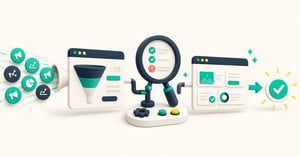
More media spend amplifies the experience visitors already receive. Audit the conversion surface first: message match, friction, attention, measurement and next-step clarity.
Quick answer
Before increasing paid-media budget, prove that the landing experience can turn incremental attention into a clear, measurable next step. Start with message match, friction, attention, measurement and the quality of the conversion event.
When a campaign misses its target, the default reaction is often to change the audience, bid or creative. Those levers matter, but they can hide a more basic problem: paid traffic is arriving at a page that makes the next step unclear.
A conversion-surface audit gives the media team and the website team one shared view of what happens after the click. It does not replace experimentation. It makes the next experiment more useful.
Start with message match
The promise in the ad, the page headline and the primary action should describe the same job.
A visitor should not need to translate campaign language into site language. If the ad promises a simpler way to manage website prompts, the page should quickly show what changes, for whom and what to do next.
Review each high-spend ad group beside its destination page. Record the promise, proof, objection and action. Any gap is a conversion hypothesis before it is a bidding problem.
- Does the page repeat the campaign's core outcome?
- Is the first action appropriate for the awareness level of the visitor?
- Is product proof visible before a form, pricing gate or demo request?
Look for friction and competing attention
Friction is not only a long form. It is every moment that asks a visitor to decide without enough context.
Count the competing prompts, navigation choices and visual interruptions on the route to the primary action. A page can be technically fast and still feel effortful when every component asks for attention at once.
The goal is not a blank page. It is a clear hierarchy: one primary path, relevant supporting information and secondary actions that do not compete with the visitor's current task.
- Check the experience on a narrow mobile viewport.
- Keep persistent controls from covering copy or form fields.
- Make error states and consent choices understandable without leaving the task.
Measure the decision, not just the click
A campaign can report healthy click-through while sending people into an unmeasured or low-quality journey.
Define a small event sequence: landing view, meaningful interaction, form start, qualified submission and any downstream outcome available to the team. Use names that explain the business action rather than the page component.
Google's event guidance is useful here, but instrumentation is only valuable when the team agrees what counts as meaningful intent. A button click can be a useful diagnostic; it is rarely the whole conversion story.
- Separate micro-interactions from qualified outcomes.
- Inspect drop-off by device and landing page.
- Use findings to choose the next page or campaign test, not to create a reporting graveyard.
Further reading
Sources
- Google Ads conversion measurement — Google
- Google Analytics event measurement — Google
- Web Vitals — web.dev
Frequently asked questions
Should we pause spend until the page is perfect?
No. Protect what is working and make the smallest evidence-led change that clarifies the next step. The audit is a way to prioritise experiments, not a reason to stop learning.